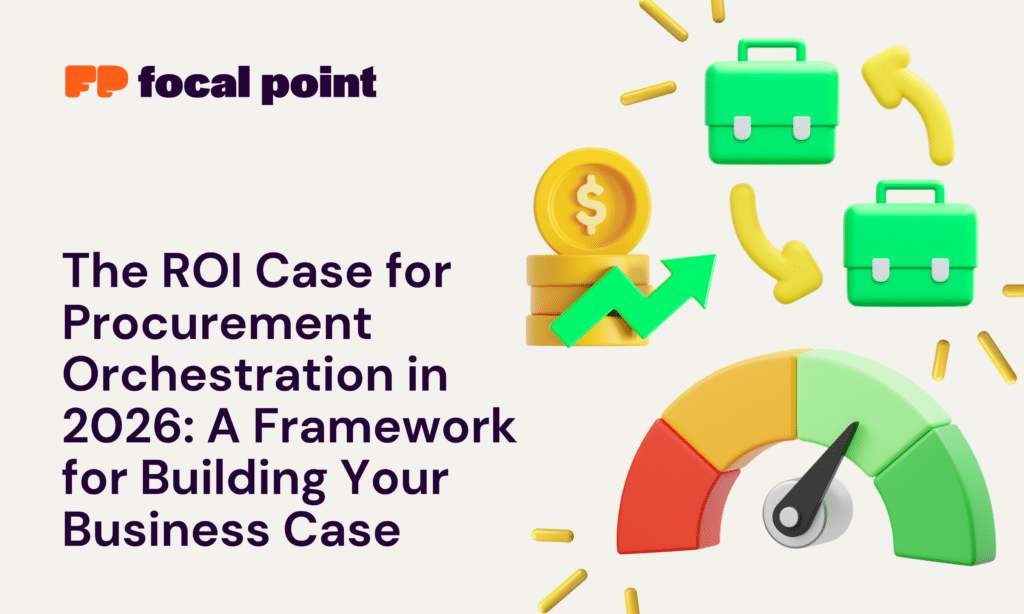
Every procurement leader has sat across from a CFO and heard some version of the same question: “We already have an S2P suite… why do we need another platform on top of it?” And it’s no secret, Procurement Orchestration ROI can be tricky to quantify.
It’s a fair question, and for some teams, it might feel tough to answer. Orchestration was easy to describe, but hard to quantify from a value-add perspective. But now that’s changed. New research is providing data on what procurement orchestration actually delivers, and it gives procurement leaders something they’ve been missing: hard numbers to build a business case around.
Here’s what the data are saying, and a practical framework for turning it into a case your CFO will actually approve.
What Is Procurement Orchestration, in One Sentence?
Procurement orchestration is the layer that connects intake, sourcing, contracting, supplier on boarding, risk, and purchase-to-pay into one coordinated workflow, so requests, approvals, and data move automatically across systems and stakeholders instead of getting stuck in manual hand offs. It doesn’t replace your source-to-pay suite or your ERP; instead integrating with them and keeping procurement’s daily processes moving.
The harder question (and the one we’ll answer today) is what orchestration is worth.
What New Data Actually Shows
Recent industry research has asked procurement leaders across quantify procurement orchestration ROI and impacts on efficiency, cost, cycle time, user experience, and AI enablement. And the data are convincing:
- 30% median improvement in process efficiency and automation — rising to 50% for top-quartile performers
- 20 days faster source-to-contract cycle times
- 25% of total cost reduction and avoidance attributed directly to orchestration
- 93% positive user experience reported among procurement teams using formal orchestration
- 2.9x more touchless purchase orders in purchase-to-pay environments
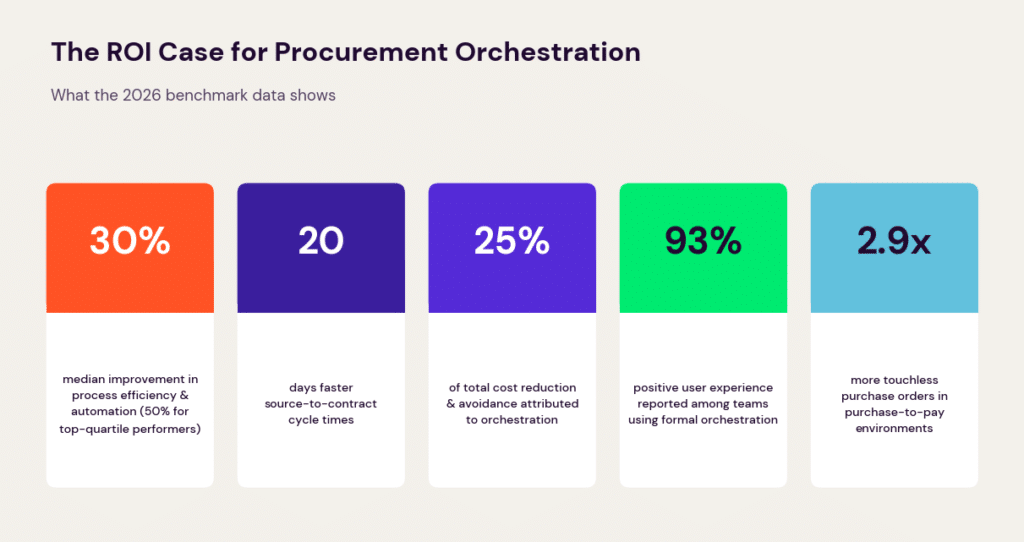
Two things stand out: first, the gap between median and top-quartile performers (30% vs. 50% efficiency gain) suggests orchestration isn’t a flip-a-switch technology, and how you implement it matters as much as whether you implement it. Second, the 93% user experience number is easy to overlook next to the cost figures, but it’s arguably the more durable win: orchestration succeeds or fails based on whether people actually use it, and this data says they do.
Building Your Business Case: A Five-Step Framework
If you’re taking this to leadership, resist leading with “orchestration is a growing category,” or something similarly generic. Lead with your own numbers, framed against the benchmark. Here’s how to build that case.
1. Baseline your current cycle times and manual touchpoints
Of course, before you can claim an improvement, you need a baseline. Pull your average cycle time for core processes like intake-to-approval, source-to-contract, and PO-to-payment. Count how many of those steps require a human to manually re-enter data, chase an approval, or reconcile information across systems. This is tedious, but it’s the number that makes the benchmark data meaningful instead of abstract.
2. Map cost leakage to specific process stages
The 25% cost reduction/avoidance figure isn’t evenly distributed, it comes from specific friction points: maverick spend from bypassed intake, missed early-payment discounts from slow P2P cycles, and renegotiation costs from contract delays. Go through your own process stage by stage and estimate where the equivalent leakage is happening in your organization. This turns one big benchmark number into several smaller, easily defensible ones.
3. Model a phased rollout
The Data suggest that phased, well-governed rollouts outperform all-at-once deployments. Structure your business case around a pilot in one process area: intake and approvals is the most common starting point because it’s high-visibility and low-risk, with defined checkpoints before expanding to sourcing, contracting, or P2P.
4. Quantify the “soft” wins alongside the hard ones
“Soft” value add, such as more positvie user experience, matters because adoption failure is the single biggest reason procurement technology investments underdeliver. When you build your case, include a section on expected stakeholder experience, fewer help desk tickets, fewer status-check emails to procurement, faster time-to-fulfillment for requesters. These are real costs today, even if your finance team doesn’t currently track them as such.
5. Benchmark your projected numbers against industry research
Vendor ‘Procurement Orchestration ROI’ calculators are useful for scoping, but a third-party benchmark is often viewed reliably by the C-Suite. Present your projected efficiency gains, cycle-time reduction, and cost savings as a percentage of research-provided benchmarks) rather than as a standalone projection from a provider alone.
Where the Procurement Orchestration ROI Shows Up
If you’re prioritizing where to start, the data point to two areas with the fastest, most visible payback:
Intake and approvals. Formalizing intake (replacing scattered emails and Slack requests with a structured, routed process) is usually the first orchestration win procurement teams see, and it’s the easiest to demonstrate to stakeholders outside procurement, because they feel the difference immediately.
Source-to-contract. Cycle-time improvement is often concentrated here, largely because contracting is where the most stakeholders (legal, finance, risk, the business unit) collide, and where manual hand offs cause the most delay. If your organization’s biggest complaint is “contracts take forever,” this is your second-highest-leverage area.
Answering the Objections
“We already have an S2P suite.” Orchestration and S2P aren’t competitors. Orchestration is the connective layer that makes your existing suite (and everything around it: ERP, CLM, risk tools) work together instead of operating as separate silos. The business case isn’t “replace what we have,” it’s to maximize the strategic value of the people, data and process your organization already possesses.
“This sounds like another change management project.” And it is, to a degree. But the data suggest that the change management burden is front-loaded and lower than typical enterprise software rollouts, precisely because orchestration is designed to meet people where they already work (email, Slack, existing portals) rather than force adoption of a new interface.
“How do we know this will work for us specifically?” You don’t, with certainty. No benchmark study or ROI calculator guarantees your results. But the honest answer to give leadership is that industry research and outcomes represent a wide enough sample of procurement organizations that it’s a credible baseline for modeling transformation.
The Bottom Line
Orchestration used to be easy to talk about and hard to prove, but that’s no longer the excuse it once was. Whether your organization ends up building a phased pilot around intake, source-to-contract, or P2P, industry research gives leaders something concrete to anchor a business case to, and a clear signal that the biggest returns go to teams that treat orchestration as a structured rollout, not a single tool purchase.
If you’re building your own Procurement Orchestration ROI case right now, start with the baseline. Everything else in this framework depends on knowing, in your own numbers, what today actually costs.