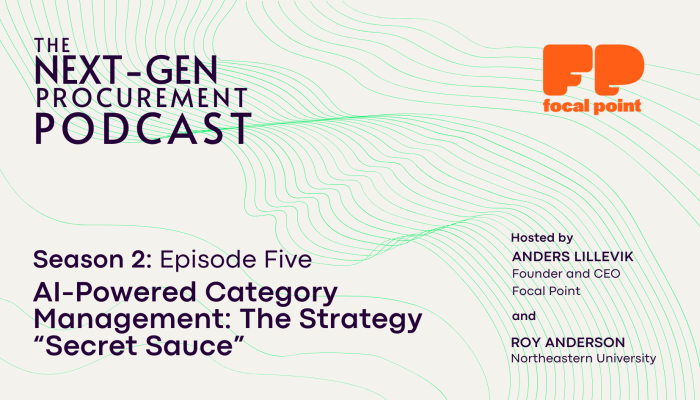
Anderson, we are here to talk about next generation procurement and we’re going
to give people a a few minutes to pile into the the channel here. So, if you’re
in the channel, uh if you want to write your name and where you’re calling or where you’re joining us from, that would be awesome. And I just want to introduce
myself and then we can have Roy introduce himself as well. Um so, my
name is Andrew Lovick. I’m the founder of Focal Point. I started this company about five years ago and before that I
spent 25 years in procurement uh working as a senior executive at companies like Fanny May, QBE, Webster Bank, Citizens
Bank and the like and and Roy do you want to also give yourself a quick introduction? Yeah, sure. Uh Roy Anderson uh been in
industry for 42 years. I had a decade with Rathon in the military and
commercial manufacturing world with Textron as well in the space-based uh operations and then moved on to services
with uh Fidelity Investments as they were exploding in the 90s. Um became the
chief procurement officer at John Hancock. Uh then moved on for a decade as a chief procurement officer at Metife
as they went went global. uh and then uh worked with uh started my own company
called Gop Procure which is still around still doing great work and uh and then now in my postindustry world I I I spend
my time teaching at Northeastern University in the supply chain program. Amazing. So you’re you’re you’re
inspiring and educating young minds in the procurement and supply chain field. Yeah, they’re they’re challenging too
those young minds. I can only imagine. and us dinosaurs who
grew up in uh in procurement and supply chain back in the ‘9s I’m afraid to say started back then uh the uh the the
landscape and the discipline now has changed dramatically and it’s continues to change and we are looking forward now
into what we are seeing as next generation procurement. So if you can go to the first slide here um
uh Maya uh today today’s objective is to
introduce the series of of bunch of webinars that Roy and I will be hosting
and what we’re going to talk about is future proof procurement in a few different things. So what that really
means is there’s going to be a series of topics that we’re going to touch on related to future proof procurement and
today we’re going to give an overview of how we see it going forward. Um so Roy do you want to add to what future proof
mean to you? Oh yeah so uh Anders as you mentioned literally the first 40 years uh we went
through dramatic changes and started the whole digital process from a very paperbased solution. uh we were able to
put in the first electronic date interchange programs, the first procure to pay systems, the first esourcing systems. All wonderful, exciting while
we were there. Nothing compared to what’s going to happen over the next 10 years. It’s just mindblowing how the
Agentic AI revolution is going to transform our our industry and and the
requirement for us to have the skill sets to be able to meet those expectations. And the best part is the
fact that, you know, we all sit around the table going, hey, we have too much work, not enough people. They keep
adding more to us and they keep cutting our staff and now they’re asking us to do the risk management and then get down
to tier two and tier three. And I personally believe that we have to rethink everything we do. Why are we
doing it? Uh things have to be done, but they don’t have to be done by us. So now it’s an opportunity of having the
technology do it, have the suppliers do it, have our internal customers take this action and then most relevant is
the fact that Aentic AI is going to revolutionize what we do. And I suggest it is going to take over everything we
do today. So that all of our future work is going to be that next generation which is way more exciting and
interesting than when anything we’ve done over the past 10 20 years. Yeah. And if I can bore everybody for a
minute, sort of the the analogy that I use when I started in procurement, it was about saving money exclusively. So I
worked in financial services and we took categories of spend to market for the first time. We made requirements generic
and we sent out RFPs and we you know the coconuts were lying on the ground like we look like heroes because we can
engage where we wanted with who we wanted and it was relatively easy. And
then 10 years later we had a shift in the in the industry. So we had Enron
fail. We had Sarbain Oxley come in and it changed the landscape because now we
had we couldn’t cherrypick our projects anymore. We need to be engaged in everything and the process became much
more complicated and complex because now you needed third party risk. You needed to do control environment assessments. You needed to do financial stability
assessment. So you went from saving the company money to saving the company from bad actors. And now in 2024 25 we also
have to save the world because we have to make sure that we don’t collute. We got to make sure we don’t hire slaves. We got to make sure that you know all
those things are just piling on top of each other and it’s becoming much and more complex and because of that we now
have some 400 plus procurement systems out there and becomes impossible to navigate. Um, so now with with the
advent of orchestration and and agentic AI, I think a lot of these things have become more streamlined and more easy to
do so that you can also save the world and it doesn’t sound as herculan of a task as it might be today. Yeah, we have
to uh what I find and this always I get a kick out of is the whole idea of strategic, you know, who’s strategic and
who who isn’t strategic and uh you know, even those that are the most u advanced
out there uh and they’re working on strategic sourcing activities in order to be able to select that final
supplier, pricing, terms, conditions, you still are after the fact. I mean the
idea is the the the concept the the type of product or service that you’re buying has already been decided.
My issue is that if we want to be able to embed risk mitigation, embed uh
competition, embed circular supply chains, if we want to embed that, we have to be in the design and development
in the R&D space for the majority of our time so that we can actually align our
suppliers, our first tier suppliers and their supply chain to have a more
robust, more resilient, more agile supplier base that’s going to be able to handle the next generation of products
and services that are going to support the company. It is there we are strategic. It is there where we’re
actually making a difference. And I I don’t want anyone to kid themselves. If you’re just doing a strategic sourcing on a predefined activity, yeah, it’s
important. Um and it is good work, but it’s not strategic.
I would like to say it’s necessary, but not sufficient to catch up with, you know, the the parlings of our time, so
to speak. So let’s touch really briefly on futurep proof. So clearly agility and
resiliency is going to be upfront and center as we continue to grow our
infrastructure and put systems and processes in place. Um what are what are
you seeing out there now that really excites you? What kind of Well, I mean in terms of resilience, what let’s let’s understand what we’re
talking about is the fact that impacts to our system our system is our supply chain. So impacts as simple as let’s see
tariffs. Uh let’s see wars around the world. Uh let’s see shipping lanes that
have been stopped up because of uh terrorist attacks or because of droughts
as noted in the Panama Canal. We we have uh very large global scale impacts to
our supply chain. And then the question is can we be resilient? Meaning, can we get past that particular impact and be
stronger than we were before? Can we learn from this process? And what that takes is for us to be able to have the
multiple supply chains that we can pull from and move our work appropriately
around the globe to be able to support those um those impacts to our supply chain.
God, yeah. I remember it seemed like very long ago now when CO came in and we had to shut down supply chains and
operations because we couldn’t get masks and hand sanitizer, right? It was who would have thought uh that we a car
assembly plant shut down because we couldn’t get masks, right? Yeah, it it is funny. The Hackit uh
review uh for the first time cost savings wasn’t number one in their list, but actually uh sustainability actually
having continuity is the word. Continuity was number one. Can we get material into the factory or into the um
in organization in order to continue doing the work that that we needed to do? That is a was a wakeup call that
says this supply chain can actually stop us. Uh where before they always said it was just a necessary evil, now they’re
realizing it is amazingly important and necessary to to continue operations.
Yeah. Incredible. Right. And to what extent do you see autonomy uh in terms
of systems doing work on their own becoming part of of the future of procurement?
I I see it uh let let’s just start really simplistically. I I would suggest to you that all of us have now uh put
our driving lives into uh maps or ways or whatever and literally we don’t take
a right or left without it telling us whether we’re going to take a right or left and it automatically rroots us when
there’s something that’s happening in front that is autonomous that is not us telling it to go do something it is it
telling us to go do something uh so that then moving into autonomous driving which is absolutely going to happen in
the trucking industry is very quickly um as the aging truck drivers are aging out
uh that autonomous driving is going to take over and that’s going to happen as we move it down to the Uber drivers,
taxi drivers, all all that type of activity. But um it is autonomous is look at everything that we do today. Um
can we discovery of suppliers uh send it setting up an RFX uh setting up a
negotiation uh all those are going to be autonomous. All of those are going to be done uh under our guidance but not
necessarily under our direct activity because it’s going to be we’re going to give it direction it meaning the
autonomous engine the bot that we’re dealing with and it’s going to take it to fruition and the fun part these things can do it hundreds at a time uh
when we are limited to one or two or three I mean how many times do you do more than five negotiations a week how many times do you do more than one this
thing can do a 100red 200 500 it will cover your entire se list that you never touched before your your C-level items.
It’s going to move into your B-level items and then the idea is can you move
to your first and second tier suppliers to give them the support because I believe some of our biggest cost savings
and innovation is going to come out of the second and third tier suppliers that we’ve never talked to before. I mean,
some of the leading pharmaceutical companies have it down to the X tier. some of the uh auto auto companies and
and the like have it down X tier, but the vast majority of companies barely touch their A item suppliers and now
they’re going to be asked to do A, B, C, and second and third tier. Amazing, right? Uh, and I remember back
in when we started doing supplier management, we struggled to even figure out who our second tier suppliers were
and working in a bank and realizing that you are critically dependent on people
or entities that you don’t even have a contract with. Right. Right. You have multiple single points of
failure with that one subcontractor. We don’t even know where those points of failure are. Right. And how do you how do you mitigate
against it if you don’t even know where it is? The other the other point you brought up earlier was agility. We have resilience now agility. It’s like how
early can you get in input to be able to make those changes? Um as I use the the
back to the ways environment as soon as that first accident that first person on ways goes I’m stopping in the middle of
the highway. It tells everyone behind it immediately like we got to find another way. So it’s like how fast can you find
out that there is a problem in the Suez Canal? How fast can you find out that your all your shipping and do you even
know if where you’re shipping from and how it’s getting to you? Uh which is now much more important in the manufacturing
world. Uh now you have to know what’s going to impact it. what what are um you
know oil prices are going to happen or or what’s happening in terms of um uh border security or or basically this
whole isolation thought process that is changing the dynamics of trade around the world and it’s happening and it’s
changing on a on a daily basis. How does it how do we know whether it’s going to impact us and can we make appropriate
changes in our our discussion and our actions in order to be able to be agile
enough to support the organization. Yeah, I couldn’t possibly agree anymore uh than that. Um last thing we’re going
to focus on sort of for today’s discussion is around all right so now all these things are happening and we’re
going to become agile and autonomous. What kind of skills skill sets do people
need? What what what what are we looking for now as we’re hiring mid mid
mid-level professionals, maybe starting professionals or senior executives? Like how does that change the game?
Yeah. What what I’ve what I’ve seen what I’ve as I’ve talked to individuals that are actually using autonomous uh agentic
AI type of activity um they need people that can see the bigger picture. they
under can understand the types of changes that are going on, the ability to to leverage this technology more
effectively. Um, you know, I hate to jump way way way back, but I mean, the people that were first able to do uh
spreadsheets, leap forward. Those people that first able to do, you know, simple programming languages leap forward.
those people that understood P2P, esourcing, uh, you know, marketplaces
would leap forward in their careers because they were able to take advantage of that work rather than being afraid
that, oh, this is going to take my job. It’s kind of like, no, take my job. I want to go to the next job that is going
to pay more and it’s going to be more interesting and exciting and I’m going to have a a larger impact on the
success, the profitability of the organization. Uh, I’ve always looked for people that want to get rid of their
job, find a way that I can stop doing this current work, more transactional, less strategic, and be able to get to
the next generation as quickly as possible. That those are the types of people. Those are the skill sets. And
it’s across the board that you need engineering experience, you need the marketing experience, you’re going to need sales experience. You’re going to
negotiate more internal to the company than with your suppliers. Um, and so they’re going to have to get those
relationships in place. And if you’re going to move into the R&D space, you’ve got to be able to think about, you know,
what type of products and services are needed five years, seven years, 10 years from now. That that level of creativity
um is is absolutely next generation requirements 100%. Now it’s funny. I had a a customer
who we set up a category management uh agentic workflow for them to basically do a porter analysis, a peso analysis, a
crawlic matrix, should cost analysis and cost breakdown structure all done agentically. And he was like, Andrew,
it’s too fast. It does too much. How are my people going to learn if all this
just gets done for them? and he has a valid point like hm how do you teach somebody that is just starting out the
fundamental of a cost breakdown structure and a and a quarter analysis if you just hand it to them
to so like to me I’m like hm that’s a good point you and I know this because we’ve done
it a billion times uh but if it gets done for you is it as effective
not at all at all I mean it well it’s important for these people to be able to
see and take action and see where they fit into the next generation of these activities and then continuous learning
uh is required. Every single person in my organization, you know, you thought training was oh that’s a nice to have.
No, it’s imperative. You need to keep learning about what’s the next generation of technology, how we can
utilize it, be creative uh in that process. And we also understand that the CFOs are not going to go shower us with
money and budget to make this thing happen. We’ve got to be creative. How do we fully utilize these tools utilizing
the suppliers current capabilities and their growth pattern uh and then drive your suppliers to be able to take
advantage? I I I’ll find I’ll suggest to you that buying new technology is one thing, but taking the technology you
have and and making sure that supplier is moving in the right direction means you have to be vocal in your
relationship with those suppliers. Yeah. And I absolutely love seeing customers get their hands on the, you
know, the AI builder to build their own agents and you kind of see how they’re thinking about it and then you can teach
them say, “No, no, no, you got to put the context in here to make sure you get the right output here and then you take that output and put that into another
context and move that forward and you see the wheels turning.” Yeah. And it’s really cool. It’s going to be critical for um the
organization, especially the leadership of the organization to be able to have transparency. You need to have visibility in the work that’s being
done. You have to find areas of inefficient resource allocation, meaning your team is just filled with work
that’s not valuable. It needs to be done, but it’s just not good work for
them to do so that they can be moved forward. Now, note, not everyone, and this is the hard part, not everyone
is capable, competent. They all work hard. They’re all good people, but there’s always a limit. I mean, all
those high school uh baseball players that never made it to college and the college players that never made it to
minor league and minor league that never made it to pro, doesn’t mean they didn’t work hard. Doesn’t mean they were amazing, wonderful people, but everyone
has their level of um limitation. And so, as a leader, I’m always trying to hire the smartest people, get my
suppliers to be able to take the next step step at no additional cost to me, and then find the right tools that are
going to create the visibility and the transparency. This is why you know Andre I’ve loved focal point is because you
see the work that’s happening and then you can manage it more effectively and then be able to drive better results
with the same or less resources. Amazing. Thank you so much. Uh so we so
for those of us who are on the ch on the chat channel or you know if you want to talk about something specifically if you
have questions that drop them in there but now Roy and I are going to talk about the future episodes about how the
future proof procurement will impact certain things but uh you know we certainly will have time so so episode
number two is what are the technical competenties that will be critical for
the future leaders of procurement. Now, we talked a little bit about the the thinking part of it, but what are the
technical things that need to be done? And if you can give us like two sentences, Roy, because I know this very hard for you.
Yeah. So, so we’ll try our best here to be. So, one of the things that I I tell my
students because the Northeastern students come from wide background, engineering, international business,
finance, accounting, marketing, the I mean big widespread. I said, “You can become uh the engineering person inside
of a supply chain working with your VP of engineering and your suppliers engineering groups and have an
incredible career path uh working that skill set.” And I believe that the technical skills that people are going
to need are much more in line with their customers. So their internal customers, the engineering team, the the production
team, the manufacturing activity, the the marketing team, the advertising, the finance organizations, they need people
that can talk to you and understand the issues that they are having so that you
can bring supplier solutions to bear on their problems going forward. That requires someone that is knowledgeable,
has the language, uh has the uh understanding of those issues versus a generalist. Generalists are great. Used
them all the time. But I I quick story. I was at Metife. I put a generalist person that understood consulting a
little bit with my actuarial. And actuarial is literally the heart and soul of insurance, right? And and he
goes, “Roy, I’ll work with you, but don’t give me someone that does doesn’t understand my business.” It’s like boom, bing, bang. It hit me so
hard. I’m like, “Oh my goodness, I need to hire people that are targeted to these these areas if I’m going to be
successful.” Yeah, 100%. Moving right along to episode number three and it’s the
opposite side of it. So soft skills and I think this is one of the things that is always popular on LinkedIn is is sort
of the whole idea of emotional intelligence connecting with your customer making sure that u you know
you’re adding value not just technically but also uh I was going to say emotionally but that probably is not
correct u you know making sure you understand their business and so on. So you want to add a little bit to that?
Yeah. So we have to uh make friends and influence people. I I need to influence
my internal customers to explain our value. I mean note I I grew up in in
military manufacturing where they had to use us and uh that has its own is side
issues going forward. And then I went into financial services where they didn’t even know we existed.
Yeah. I’m the chief procurement officer. What the hell is that? They said, “Well, we run procurement all the suppliers.”
like I’ve never seen you people before in my life. So the idea is to train them to explain to them the value you bring
to the table, not just say, “Well, we’re very important and we’ve got to be there at the table.” I tell you, unless you’re
bringing value to those internal customers, they throw you right out. Uh I I always get a kick out of people that
tell me, “Well, we should be at the CEO’s table.” I said, “Yeah, I sat at that table and they are very smart
people.” And if you don’t bring not only your expertise but the company’s holistic expectations to the to the
bear, you’re gone. You’re out of that table in a heartbeat. So be very very aware of the fact that you’ve got to be
uh talented in your skill set, your domain, but you have to have a holistic understanding and you need to be able to
hear and feel be empathetic as a soft skill uh to your CIO, your CFO, your
head of production, your head of design, your head of marketing because they have their own set of issues and skills and
they they realize if you’re adding value to the supply chain that helps them get their their uh goals done, you’re in.
You You make it a burden, you slow them down, you become a problem, you’re out.
It’s very, very true. Episode number four is all about um resilience and risk
management. So we this is something that we are so used to hearing about and talking about and you touched about it
very briefly ear earlier in terms of being able to react quickly being able to to to uh figure out the impact of
stuff. Add two sentences to this about why you why people want to tune in to episode 4. Yeah, episode four. You all know how
important it is. Uh the risk management we used to just paper it over and tell suppliers, well if you mess up, you’re
going to have to pay. Like that doesn’t cut you. As a supply chain manager, you have to have the supply chains that’s
going to be risk mitigated. It has the right suppliers around the world, which
is going to expand the number of suppliers. Guess what? When you go from two suppliers to four suppliers, it’s
going to be a difficult play on cost savings. But you have to be able to manage risk mitigation and cost savings
by driving innovation, transparency, and eliminating all those things that make you more expensive. what I call be the
lowcost customer. Drive any excessive expenses, hurdles that deal that the
suppliers deal with you. They have to be uh eliminated and you have to be faster,
leaner, more effective, more transparent with your suppliers to be able to drive both risk mitigation, resilience, and
lower cost structures. Hallelujah. Couldn’t couldn’t agree more to that. Uh the final episode that we
have scheduled for now are all around ESG and I think a lot of people go
what’s that again you know I think it’s taken somewhat of a backseat now certainly in the United States uh with
the current focus but we want to talk about ESG and also G is also governance so we have to keep that in mind there’s
still going to be a lot of governance on your suppliers so this is what I think is is probably the best opportunity for
agentic AI and orchestration personally abs absolutely governance is crucial Governance is that transparency.
Governance is you have policies, procedures, how do you run your organization? How do you have your suppliers run the organization? How do
they fit in more effectively? But you have this concept that you are still an entity living and breathing in an
environment. Um, and the environment requires uh suppliers that support that
local environment. I mean diversification of your supply chain can be risk mitigated but also can support
your local uh environment your local community. I mean you we all still live
in communities and we need to create businesses and and create value in those communities. I did a study a long time
ago. It says, uh, when I was CPO at John Hancock, uh, Wheaten College in Norton, Massachusetts, uh, they had a a deal to
find out how does a million dollars from John Hancock going into a organization
in the local community impact the organization. So, not only does it give the owner of the company money, yes, but
their um, leadership skills, but also they hired more people from the community to to meet those requirements.
Mhm. And those community members, they then bought from the local bakery, the local tire shop, the local supermarket. Uh
that money multiplied. So if you’re an economist, it’s the multiple of money um
to be able to say four and five time return. So for every dollar that went into the community, you get five times
the amount of value. So the the s the social element of this is is critical.
And of course environment. We live in this tiny little circle in the middle of the universe
that is limited on resources and has a real pollution problem. We need circular
supply chains. We need to be aware of the products and services and the resources that we’re using for our
products and services and how we can get it back into the environment rather than just throwing it away in the dump.
Dwight, I think everybody including myself love you loves your passion um about these things and and you are
almost as big of a procurement nerd as I am. So as we uh you know so so right now
on the screen there’s a uh QR code that you can scan with your phone to learn all about our second episode that is
about the tech shift in procurement tech. And while we while you sign up for
next episode, uh Laura has a question related to autonomous sourcing. So she
talks she asks a questions like how and I’m going to summarize here like how do you see autonomous sourcing being being
impacting the business in one to two years and for the next two years it is going
to explode like every other technology it is currently immature it is doing um
seale negotiations it’s doing early supplier discovery because you don’t
have the breadth and uh of of information that the autonomous Now remember, an AI engine can take feeds
from thousands of sites and be able to understand which are the top two or
three. So areas that you just don’t have the bandwidth to go after, the Agentic
AI solutions can start to give you suppliers you never even thought were a possibility and now you can bring to
bear. They the Agentic AI is actually going to start issuing RFPs where you would say, “I don’t have the time for
this. I’m just going to call one supplier.” And you tend to call the incumbent supplier, which is always not necessarily a bad move, but not
necessarily the innovative move. If I’m the incumbent supplier, you definitely should do that, but you know, any other time, not so much.
That’s right. And and then that that there’s the opportunity of being able to negotiate these smaller items at the sea level,
which are significant risk and significant opportunities for savings. Uh and then allows you to be able to
collect data as to what their tier 2 suppliers are. The AI engines are going to start to understand what all the tier
2 players are. Start to map it out so you can actually see the areas where one supplier is impacting a larger portion
where the the choke point is where the risk really is and then what do you have to do to mitigate that risk by working
with your suppliers effectively. So the next two years you’re going to see it popping up everywhere. Every single
supplier is talking about their AI efforts. Uh many of them are still vaporware. So, just be aware of
vaporware. Talk is cheap. Show the results is what you’re going to need. Um, but you know
what it needs more than anything else? It needs customers like you, procurement people that are educated and willing to
invest. And invest meaning buy their services, buy that activity, give them the revenue stream that they need to be
able to divide in that. And then give them your input, your insights to make it better, more personal, more
appropriate for you in your industry. It helps the technology develop faster and
uh yeah, it’s going to change out. Guess what? You got to be uh agile enough to
be able to handle that. That’s going to happen. Not it’s not a big risk. Doing nothing is the big risk, you know. So,
so do something. So, with that everybody, thank you so much for spending half an hour with us.
Uh we didn’t think it was going to take half an hour, but somehow it did. Uh thank you so much for joining. Uh please
drop us a note if if you want to talk more. We’re always interested to talk to procurement people about what they do
every day because guess what? Uh we love procurement and and we’re passionate about it. So thanks thank you so much
for joining us Roy and we look forward to to our next episode. Absolutely. Have a good day.