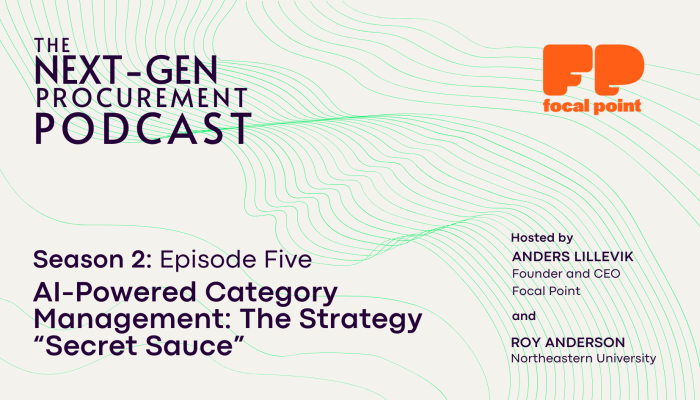
is Andrew Livik. I’m the founder of
Focal Point and with me I have my
esteemed colleague uh Roy Henderson who
is a lecturer at Nor Eastern University
and you are now tuned in to episode
three of the NextGen procurement uh
podcast. Today we’re going to talk about
playing procurement politics and it’s a
little bit about how we uh become more
effective and efficient as procurement
leaders inside companies. And if you
guys have joined, just joined, can you
please drop in your chat where uh you
guys are calling in from? Uh sort of as
an icebreaker here. Uh myself, I’m in
Atlanta. And Roy, where are you in the
I’m up in Sandwich, Massachusetts, right
Wow. Beautiful Cape Cod. Fantastic.
Well, let’s get it going. Uh Maya, can
you go to the next slide so we can talk
about the today? So today we’re going to
talk about how um EQ or emotional
intelligence effective communications
and P people management can make
procurement better and basically how do
we achieve our objectives alongside the
objectives of the business that we
serve. Um you know what what I always
like to say is procurement is a team
sport and how we sort of interact with
other folks really influences how
effective and efficient we will be. Roy,
any starting sort of thoughts before we
jump into the to the script?
Well, I I find that the um ability to
work and understand how uh individuals
are uh looking for help to be have
empathy uh it goes a long way. So, you
have to have the skills, you have to
have the technology, but you need a
significant amount of empathy to make
this uh this process work.
100%. So why don’t we start off with the
and it’s a bit uh I would say uh it’s
it’s more of a religious thing than a
real hard hard and fast thing. But Roy,
how do you typically think about the
relationship with procurement’s business
Yeah. So if we if we talk about the
business user, we’re talking about our
internal customers uh uh in this process
are in you know I look at at it they are
our customers. Now, unless you’re in the
military where there’s a requirement
that you utilize the process, most of
the companies I worked with post RAON
all required me to sell the concept of
using the uh the procurement function
going forward. So for those of you that
are in the mandatory stage, you may not
have as much of this, but uh all the
rest of you that are you are
an element if the internal customer
wants to use you going forward. Um
that’s that’s the key. So business users
number one in the entire structure is
you have to listen first because if you
start telling them all the values you’re
going to bring to the table, they’re
going to say you don’t even know what I
do. you you don’t understand what I’m
trying to accomplish. Um therefore, I
don’t want to do anything to do with
you. So, I would always start with a
significant listening and I would
explain to my teams that if they don’t
spend the first 20, 30 minutes of every
meeting just listening to the internal
customer, then they’ve blown it already.
It’s very true, right? Because uh I
think it’s a very powerful thing. People
love to talk about what they do and if
you open up with saying hey I would love
to understand a day in the life of of
you and your team you’ll be hardressed
to find people who want to actually tell
you stuff. People love talking about
themselves which is the easiest thing to
sort of get the ball rolling right.
Yeah. The other thing that I sort of
always told my teams is that just like
you, your stakeholders, all of them are
trying to achieve their business
objectives, right? So they are act we’re
actually working for the same team. We
just serve different roles. And the
moment you stop thinking that your
business partners aren’t trying to
achieve their objectives, I also think
you have failed. You need to think about
in that context like they want to get
this marketing campaign done or they
want to get this print these printers.
sorry, have put posters printed or they
want to get this new system to do X, Y,
and Z. They care less about what it
costs as long as it meets their
requirements. Like that’s what they care
about. At least most people do, right?
and far beat for me to say if we save a
million dollars for our customers, far
beat for me to take that million dollars
away from them. That’s finance’s job
very often to say, “All right, you got
something for less than you thought.”
But I always also thought about the fact
that procurement often uh feels bad
about the business spending the money
that they’ve been allocated which I also
don’t think is a necessarily good thing
but you know you can’t blame them for
doing that because guess what they’re
going to maximize their uh objectives
you know and using everything they have
their disposal to do that.
So after nine years of working at Rathon
in the whole military pound the supplier
u mentality that that they were pushing
into me. That wasn’t the only thing they
pushed into me but that was a concept
that was pretty reh prevalent going
forward. I I I show up at Fidelity
Investments and I tell one of the fund
managers I said hey I can save you a
million dollars. And the guy looked at
me and said I don’t need you to save me
a million dollars. I make this company a
million dollars a day. I need you to
help me to make $2 million a day. So,
whoa. Cost is really not the issue here.
We’re talking speed uh quality levels uh
extra innovation in this process. Their
entire requirements were radically
different. And if I if I didn’t hear
them uh and unfortunately I started
talking first, learned that lesson. What
do they need? They’re trying to get
faster delivery. They want to have
bigger, better, smarter suppliers, not
the lowest cost suppliers. It was just
that’s a whole different model. I said,
I get it. Now I understand we’re looking
for a different supplier that’s going to
be able to double your pace, not
necessarily the lowest cost. And I tell
you, that was a wakeup call to me.
I had a very similar wakeup call at
another at another very large financial
services institution. And the quote was,
“Unless your saving number starts with a
B, we don’t care.” Which which was
quite, you know, eye opening as well.
But they were man they were managing
trillions of dollars. So I I I
understand that now right it’s all about
for them it was all about throughput not
necessarily about this the best
procurement process or saving the most
money. Um all right so second topic here
the people that are part of the
procurement process but aren’t
necessarily under our tutelage or under
our umbrella. So procurement I think
very often gets blamed for processes
that are out of our control
uh but are part of our process. So how
how do you think about those folks in
I think we have to start with um a
listing and and understand everyone is
at a different starting point where they
are in their maturity process. I’ve met
an awful lot of companies that are still
in the paper mode which is painful but
realistic, right? you’re gonna you have
to deal with those. Uh and then there
are problems that you you’ll face
implementing technology because the data
behind your partners, your geo codes,
your cost centers, your hierarchy, your
email addresses, those are all
problematic and they’ll show up inside
of your e procurement system. But
putting that aside because we did talk
about technology in an earlier session,
uh one of the first things that I would
always do is go and work with the
auditors in the group. uh and I felt
that you know we were uh two parts two
sides to a coin is they went in to a
particular area because they’re looking
to say hey are you following pol do you
have policies uh are you following the
policies that you do have uh you know
are there things happening that are not
um above board or could be problematic
to the company. So the auditors
frequently when I talk to them I said
hey you’re going to find things where
they’re doing dealing with suppliers
that I’m your solution. I can actually
go in and if I go through the process
that we do effectively with having uh
transparency and appropriate bidding and
requirements building and uh accurate
ethical negotiation strategies that
we’re going to be able to solve a lot of
the problems you may see. Uh on the flip
side, I’m going to go into some sourcing
arenas where we’re seeing some problems
that are bigger than just the supplier
that their internal processes, the
people that are utilizing activity uh
may be playing uh loose with what’s
happening and therefore the audit team
is going to be able to get brought in to
be able to look at those in more detail.
So, I always felt the audit team was a
really good partner with me uh to be
able to support their efforts and then
them to be able to highlight areas of
opportunity for me to get in
Roy, sorry you blipped out there for a
second. And I mean the audit, you know,
personally I have a I have a complicated
relationship with audit because a couple
of times I’ve engaged audit and told
them about the problems that we have
within the process and here and there
and the other thing and then they gift
me with with audit findings outside of
an audit and they start tracking those
items which you know sort of puts a
bittersweet taste in your mouth because
then why on earth would you sort of
disclose issues to audit uh and it when
it counts against you? The other the
other thing that is always interesting
when we now go into um customers and we
start implementing processes right so we
can with your focal point you can say
all right this pro you know this person
here and then you go to legal IT
compliance audit whatever’s on the chain
and all of a sudden you know you have
the visibility about how long things
actually take so how long before
something shows up in their queue before
it gets assigned how long do they work
on it before completion how many back
and forth and those kinds of things and
it’s incredibly eye opening because you
know it brings it to the four and what I
always try to tell people is you have to
use this as as a gift of feedback
because before it’s just insinuations
that oh legal takes too long well that
maybe may be because the supplier that
takes too long or it could be variety of
reasons but you don’t have any real
evidence of that without looking through
somebody’s emails change those kinds of
things. So having at scale how long
things take and how long sit something
sits on somebody’s desk becomes very
powerful and you can use those things to
improve the process and maybe even work
better with those stakeholders give them
the information that they require
earlier in in a better way perhaps so
that they can complete their tasks
quicker. So I think we’re also rowing
the canoe in the same directions and
we’re trying to achieve efficiency risk
mitigation and and those kinds of
things. So we need to work from the same
himnotes. Uh but I also think as as the
face to the quote unquote customer,
internal customer, you know, we need to
also open up the commodo and show them
how the sausage gets made with us with
the internal stakeholders so that it
becomes open and and you know
transparent about what goes on what goes
on and when and with whom. Yeah, it’s
really great when you have focal point
to be able to highlight the front end of
this process so that there’s
transparency and visibility and
therefore the ability to move things
along uh within the policy uh structure
that you put in place. Of course, I’m a
big believer that uh you know policies
have to be broken because in most cases
the policy was written during a uh
analog phase, meaning a paperbased phase
where a lot of things were put in place
that are not needed in the digital world
uh and especially not in an AI digital
world. So I think policies need to be
reviewed on a regular basis. Now, you
brought up legal. Uh I had a good
conversation with uh some individuals
that were in the legal area and they
were talking about how fast they need to
get things done and that speed is more
important and and my point of view was
um I want the contract to be done on
time. Now, if if this contract takes
nine months, then you need which is if
possible, right? If the contract is a
part of a sourcing process and you have
some really in in-depth um
indemnification activity or warranty
issues or or propri proprietary
material, it may take a long time. My
issue is well did you start 10 months
ago so that when the contract is closed
up and ready to go, it’s days or weeks
before the the need. Whereas some were
saying, oh well, I get the contract on a
Friday and the person starts on Monday.
Well, I don’t care what you do, you’re
going to have a horrible contract. The
legal team is stressed to the limit.
You’re not going to get a very good end
result. And likely the contract won’t be
signed off until Tuesday or Wednesday at
the best. So now it’s not about the
speed of the contract because obviously
if you can get done in three days, that
should be a a hero moment. But in
actuality, some contracts do take nine
months. Some contracts do take 60 days.
Therefore, are you changing your whole
model to be able to start early enough
in the process? And do you have
visibility that it’s going to take that
long so you can actually be have the
optimal contract do done in the
appropriate amount of time on time? I
mean, that’s that’s the key from my
Yep. 100%. and without uh without being
able to confidently communicating to
your stakeholders like if it’s a brand
new supplier and it’s a complex work it
typically takes this long it’s kind of
you know interesting right um speaking
of reporting right um topic number three
how do you think we should communicate
procurement’s value to the business user
or to the to the enterprise as a whole
and I I’ve you know you and I have both
been part procurement organizations and
we always try to get the best be put in
the best light with our business users.
how how do you think you can
so some of the things that I found
consistent uh with my internal customers
now again I’m talking about on the
financial services side uh or the
non-military manufacturing side um or
even on the indirect side within a
manufacturing or organization uh they
have some common concerns legal slowing
them down audits on their back finances
giving them what they need so they have
these uh groups that they’re like how do
do I get them off my back? And one of
the areas after I hear things like that,
I said, well, one of my values is if if
we work together, I’ll be the person
that has to handle audit, legal,
finance, uh, on your behalf, so you
don’t have to. And by the way, I’ll make
sure that they never find a have a
finding against you. They’ll they’ll
never be able to say you’re you’re
overbudget because we’re going to get
you the suppliers and the contracts to
make sure you’re on budget within policy
and have the contractual language that
legal be forward. And most of the
internal customers saying that’s value
number one. Forget pricing. Forget if
you can get them off my back, huge value
to me. Let’s go. So if you hear that,
then that’s one of the values that you
want to be able to get across to them.
So, so, so keep you out of jail card.
Well, you know, the funny thing is,
right, when I started in procurement, it
was all about saving money. And as the
procurement role kept growing and
growing and growing, we kept reporting
savings because that’s what we were used
to. That that how we justified
ourselves. And as I continued to sort of
become more and more entrenched in the
organization, we started reporting on
other things like how many suppliers
onboarded, how many risk assessments did
we run, how many POS did we get out the
door. So like they understand the the
you know the volumes and the metrics of
the organization. It’s not just that RFP
that we do for you. It’s all these other
things and how many suppliers we’re
managing and those kinds of things. How
much capital we freed up as part of you
extending uh pay payment terms and those
kinds of things. And what I will say is
is this like the the business a CFO will
not necessarily know which metrics to
ask for. So they’re not going to tell
you what to report. But if all you want
to be measured by is savings, then by
all means go ahead and report on savings
day in and day out. But if you want to
enhance the the value of procurement and
the and the and the uh perception of
procurement, then you need to report on
totality of the value that we bring. And
and one of the things that I love as
part of implementing focal point is we
have uh what we call a net presenter
score tool or functionality where every
interaction after every interaction with
procurement. You can send them a net
promoter score survey. It’s one
question. How did we how did we do
today? And it’s from 1 to 10. And
obviously net promoter scores we all
we’ve taken them all the time, right? So
not just time, value, uh quality, but
also how did we do it? Did we do it in a
way that was pleasant sort of to to be
to be around? Did we interact with your
team in a way that you enjoyed? And I
think having that 360 degree view also
helps procurement in in communicating
value. It’s a bit squishier than
savings. Um and uh but but I think it
really works. uh and a few folks are
sort of leaning into that now because
most organization when they do a net
promoter score survey is is for
enterprisewide for the company and if
somebody did two two project of
procurement six months ago they may not
remember so it’s at that moment in time
in real time value absolutely the faster
you can get the person to say hey if
you’re mad I want to know now and if
you’re really happy I also want to know
now don’t don’t wait through the end of
the quarter or the end of the year
because the results are just not
valuable uh another another opportunity
is I’m a big believer in the whole
concept of innovation that as
outsourcing has been prevalent so many
uh functions are now with suppliers you
realize that the the new ideas uh to be
able to improve are going to need to
come from the suppliers. So one of the
areas that you can add value to the
internal customer is understand what
problems they have and how do suppliers
uh provide them the innovative
leadership, the thought leadership, the
technology plays, the new product lines,
the new solution sets that be able to
solve their problems internally. And
because we’re that in many cases the
intermediary between the suppliers and
the internal customers, we need to
promote that innovative mindset and be
open to getting uh suppliers talking to
internal customers on a reasonable
level. Now no, there is that balance
that every supplier and there’s
thousands of them are want to talk to
internal customer and then you’ve
overwhelmed them. Now this is the hard
part is do you know which supplier can
provide the greatest amount of value in
the most efficient manner to be able to
communicate the internal customer the
way the internal customer wants to be
communicated with. Maybe it’s spec
sheets, maybe it’s just you know idea
generation, maybe it’s a a a 20 minute
meeting once a quarter. However that
internal customer wants to interact with
suppliers, you make sure the right
supplier has the information necessary
to be able to bring that innovative
thought leadership to bear.
Yeah. And you’re 100% as well and I
think it’s very powerful to be able to
ask your most important suppliers, what
have your other customers implemented
that prove value that we have not.
Suppliers would love for you to u to get
more value from the relationship. So,
and and yet we don’t always ask for
that. So, I think it’s a it’s a good
good point. All right. Uh topic number
four, and this is the hot one. How can
we be creative to help drive investment
into the function? And this is kind of
like blood from a stone type thing. So,
So, multiple areas. Um at first,
whenever I went into an organization and
you know that there’s a significant
transformation that’s coming, so what
are we talking about? said, “Well, the
the organization is uh performing poorly
across the board.” Uh, as Andre, as you
probably recognize, the only reason a
CFO brought me in is because they wanted
to see change happened with it wasn’t
I’m not the status quo person. I am the
person that goes in and in order to be
able to create significant skill set
adjustment, technology implementation,
supplier uh enablement uh in the
process. So uh one of the key elements u
is the fact that you’re going to be
changing out your u split of your
budget. So the procurement function has
people uh they have training, you have
technology and you have thirdparty
support in most cases that that takes up
80 plus% of your your budget. The rest
is um whatever cost that the the
company’s incorporating. But you start
to realize like oh wait a minute should
my budget be more tilted towards
technology. Therefore, as as we look at
headcount, how many headcount am I going
to need 6 months from now, 12 months, 18
months out, what skill sets? And you’re
going to find that higher level skills
are going to require a greater budget,
which which key pain point is your job
descriptions are probably ancient and
not telling the right story and
therefore you’re not getting the um
internal HR compensation team to provide
you with the right compensation
structure to bring in the skill set you
need. So, a Monday, redo all your job
descriptions. Uh, and then, uh, you’re
going to be able to say, “Okay, I had
three headcount. This was a, you know,
let’s make it easy, $300,000 part of my
budget. I’m looking to go back down to a
two headcount at a higher rate, freeing
up some money, and then selling the CFO
that says, “Hey, that that 60 or $70,000
if I bring in a focal point that’s going
to create transparency and enablement
and speed that I can get a return on
investment, that’s going to make it
worth your while.” Um, so the money is
actually coming from within my own
budget as as step one. So, that’s step
Well, I think I think you bring up some
some very interesting points, right?
Because I have also been brought in to
be to change something, right? So, a you
know, bad audit reports, multiple CPO
turnovers, they need, you know, the
company needs some some real change and
you get there and nobody realized that
that was going to cost money, right? Um,
and it’s always an interesting
discussion because they they expect
procurement to self-fund.
And I think that’s actually not a bad
way of looking at it because I think for
for most of the organizations, we
probably can’t self-fund.
And what I’ve always done certainly in
in in smaller organizations is gone
after the the biggest spend provider
that they had and try to renegotiate
that contract and get that big win. uh
and that typically at least three or
four times I’ve done it has has yielded
enough attention to sort of get
investment into the function. The other
thing that I always try to look at is
are the are the nonobvious ways of
looking at it. So for example the
procurement operations piece are we
paying our suppliers too early? Are we
not taking advantage of the capital that
we could be taking advantage of? We
actually paid the term. So looking at
things that like look all we need to do
is pay based on the actual contract
terms rather than it’s paying it the
second invoice comes in. You’re picking
up some stuff there and if you then can
expand that payment term from 30 days to
60 or 45 days here’s a working capital
you pick up and unless we actually
monitor those things ongoingly
you know you could lose that again. It’s
it’s selling the the idea of you know
having proper oversight having proper
governance then create and maintain
value rather than you know negotiating
the contract uh letting the business go
and then all of a sudden the pricing
creeps up again because of change orders
or because of price increase or whatever
the case may be. And a lot of people
continue to look at procurement as the
contract negotiators which is not what
we are right. uh if you want a contract
negotiator, you can hire third parties
for that too, but you’re not going to
have lasting results. Um the other thing
though as we are going into
organizations is procurement technology
now can span into adjacent functions. So
do you need an archer for example for
risk management? Do you need two or
three contract management systems in the
in the organization to manage your
stuff? Right? And very often I think
there’s consolidation opportunities that
can be taken on but very often it’s an
uphill battle because people hate change
if it they’re not driving it themselves.
So it comes back to point number one is
how do you deal with your internal
business stakeholders to make sure you
can achieve efficiencies in a good way.
Um but you know I I have never had a
customer come to me and say it’s really
was really easy to get money to buy
something right because it’s not it’s
just not. We’ve had so many times when
I’ve sat in the CFO meetings with the IT
teams, they go, “Okay, here’s all the
projects and we’re going to go by ROI.”
The ROI with a, you know, the greatest
return on investment is going to
actually go through. And then they go
back and say, “Well, these are being
required by government regulatory. These
are being required by tax law changes.
These are required by our customers.”
And then now we’re doing the all right.
Oh, there’s no more money in the budget.
Uh so I may even have the budget money
but I don’t have IT resources to be able
to make that happen. Uh which is why I
really uh focused on my technology
providers being able to provide that
effort uh in the process. Now we we did
go into talking about renegotiation. Uh
what I found is as you as we worked out
the sourcing plan and incorporated the
the entire organization, there’s lots of
duplication within the organization.
They don’t even realize. I mean,
companies buy and sell parts of
themselves and all of a sudden there’s
two communications groups or two
advertising groups or and there there’s
a duplication. So, there’s an
opportunity to streamline that will free
up funds within the budget uh from those
duplications. And the goal is, hey, when
those funds become available, we’re the
ones that helped you find it. Give us
some of those funds to be able to find
more of those areas of opportunity. A
third area that I found effective is
that as you go out to sourcing and you
have spend that’s happening or or costs
that are happening inside the company
that the suppliers can do more readily
and faster. All of a sudden you can
negotiate all those additional services
that used to cost you headcount or
technology dollars that now the supplier
is incorporating in their now lower
negotiated holistic cost structure. You
have now lowered the cost structure and
eliminated some internal costs
associated with the fact that the
supplier can provide that technology,
can provide that service level and now
you freed up more dollars internally.
Again, you have to be very aware of it
so that your CFO uh is uh knowledgeable
and where did it come from and what
budget is it being pulled out of so that
you can actually go after that.
And the last one and this is going to be
the last one. Never let a good uh
screw-up uh go go go by without you
taking full advantage of it, right?
Never have never have an emergency go by
that you don’t take full advantage of.
And what what I mean by that is, you
know, we’ve been around long enough to
know that suppliers are going to fail or
there’s going to be fraud or there’s
going to be this, there’s going to be
that. And what I find is procurement
tend to sort of cow in and say, “Oh my
god, it’s our fault.” Well, if we have
if we don’t have the right
infrastructure to actually go through
the processes to validate things on an
you know, then these things could happen
more easily, right? And and what I find
is procurement leaders who sort of lean
into and say, “Look guys, I’ve asked you
for investment eight times and every
time you say no, you know, this, you
know, this could have been avoided,
right?” And I think then the CFO or
whoever is managing the risk will say,
“Yeah, that’s not a bad idea. we can
invest half a million bucks in
procurement to avoid a 10 million $10
million loss. It’s an easy thing to do.
So, never let a good emergency uh pass
by without taking full advantage of it.
Um, now we’re on our final slide here.
So, if there’s any questions from the
audience, please let us know. Uh and
while we have this uh slide up here,
please use the QR code on the screen to
uh get into our next episode, episode
four, which is all about procurement
risk and being resilient to dealing with
our ongoing crises that are coming up on
a regular basis. Um Roy, thanks a lot
for having uh having time to spend time
with me. Uh always a pleasure. Any
Well, do everything you can to uh do
things that require zero talent. things
like be on time, be kind to other
people, show respect, be coachable,
listen. Doesn’t take a lot of talent,
doesn’t take a lot of time. Good things
Yeah. And you have to be a friend to get
a friend. That’s that’s what I try to
tell my son all the time now that, you
know, if you come in guns blazing, it’s
probably not going to end very well. So,
thanks everybody and hope to see you