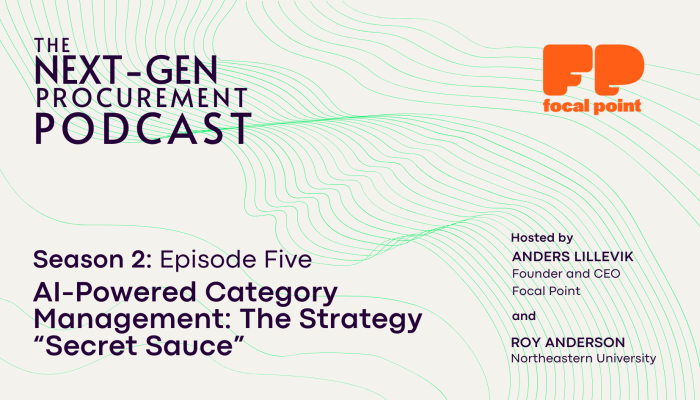
Welcome to the uh second episode of
NextGen Procurement. I am joined by my
esteemed uh guest Roy Anderson from Nor
Eastern University and today we’re here
to talk about my favorite topic which is
procurement technology. Uh Roy, you want
to start off by giving your giving us
the nickel tour about Roy Anderson?
Yeah, nickel tour. Uh 42 years in
industry u started with Rathon and
Textron military DoD procurement uh and
the FAR and all those issues. then moved
into financial services. Uh grew out the
Fidelity Investments procurement
organization, homegrown procure to pay
uh then uh CPO at John Hancock, Metife,
State Street, ran my own company, Go
Procure, um and for a decade and then uh
jumped into uh teaching full-time. I
taught during in the past with Ruters
and the like, but now with Nor Eastern.
And as I was just telling Anders, I’m
starting my doctoral program in
September at Babson College.
Sounds excruciating. But you know what?
If you got nothing else to do, why not
sorry, a DBA. Uh for those of us for
those of you who are joining now, uh
please drop where you’re calling in from
in in your comments and uh yeah, so we
can get some conversation going. And if
you have any questions at all, feel feel
free to drop them in uh the chat. So I’m
Andrew Slovik. I’m the founder of Focal
Point. I started Focal Point five years
ago after having spent not as much time
as Roy in procurement, but I spent 25
years in procurement and decided it was
time to start something new and that’s
why Focal Point is here. So can we
advance to the next slide, please?
today we are going to talk about uh
technical competencies and tools for for
uh future procurement leaders. So
there’s a lot of changes in procurement
and procurement technology. And as you
can see I’ve actually seen some of these
computers that are on this screen. um
kind of it blows my mind a little bit,
right? Thinking about all how the
technology has changed and how much
processing power now sits in your in the
palm of your hand compared to what you
were using before. But essentially,
we’re here to talk about what
procurement technology now is starting
to look like, what people need to think
about as they’re advancing on this
journey, and what are the tools and
knowledge and skills that folks need
going forward. Sum sum it up for Ryan.
Yeah, it’s it’s amazingly uh fast and
All right. So, let’s get to topic number
one. And Roy, I’m going to let you start
How do you know the time is right to
invest in new technology? Because it
always seems like people are waiting for
Yeah. Uh those that wait lose period. uh
you you will never get you know so far
ahead of the technology that um because
you just can’t implement it fast enough.
My issue is take a pain area that that
utilizes a lot of bandwidth meaning your
human capital which is the most
important part uh and if it takes up a
lot of human capital you’ve got to
replace it with technology. What does
that mean? The human capital has to
change. Absolutely. The skill sets have
to change and we’ll get into that later.
But now’s the time. There is no
yesterday done. Uh tomorrow just keeps
going forever. Today find your areas of
opportunity. Understand what the
potential is in terms of uh each
element. And I would stay with the fun
fundamentals that creates clean data
going forward so that you can streamline
and automate and then take advantage of
the AI tools that are coming through.
That’s an interesting question. Right.
So I always looked at it a little bit
differently. Right. First of all, you’re
absolutely correct. But the way I kind
of look at it is when you start having
your incumbent providers saying, “No, we
can’t do that or we don’t do it this
way.” Every time you come to them with a
new requirement that you’re hearing
about in the industry, right? So, if
you’re dealing with some of the legacy
source to pay or you have a stack of uh
point solutions and you just aren’t
keeping up with the time, so to speak, I
think that’s a good time to sort of
start thinking about either reinstalling
the stuff that you already have because
don’t you don’t necessarily have to
throw the Bailey out with the bath
water. If you have a modern solution
that could be upgraded, maybe that’s a
good good way of going at it or then
start looking at at new technology.
Yeah, I’m a big believer that if you
have something in place, use it to its
fullest, challenge that supplier to be
able to expand appropriately. But if
they’re not, then then you then you need
to move. But I would suggest that as the
leader of an organization and filter
this down through your entire
organization, get out there, find out
what’s coming, what’s down the line,
what you can incorporate, you know, what
are the best and brightest ideas because
you want to always be the creative
element uh inside the organization. That
doesn’t mean bleeding edge even though
most of my career was bleeding edge but
and I enjoyed it out there uh because I
wanted to push the technology
but be out there so that you can bring
in those things that are going to make
an impact to your organization. So one,
you have to know your organization. Two,
where the pain points that you’re not
able to support and technology can. And
then make sure that you’re talking to
the best and brightest in the industry
uh to know what what is the next
generation that you want to be a part
when people go and try to implement new
technology, are you envisaging that they
come pretty big for the business case
about how much, you know, they’re going
to save from time, effort, cost, and so
on and so forth? Well, I’m a believer
that you have to have an ROI for the CFO
to give you anything, but I’m also a
believer that your budget has to be
flexible and you’re going to lose
headcount. Um, which is good. You want
to lose headcount costs and move that
into technology base. So, they’re actual
cost to the organization is equal or
lower than it was last year or the year
before. Um but the output the capability
uh is going to be that much greater
because the technology will create
synergies with your internal teams. Of
course that gets us to the other slides.
You have to have the skill sets in order
to be able to take advantage of it.
Correct. So maybe we move before we go
into skill sets, we talk about we can
get to topic two and this is an
interesting thing right because I’ve
posted a bit about this is when we
approach uh prospects and so on and we
say look we got this whisbang tool that
can do this this and this and they will
say something interesting like well we
SAP or we implemented whatever like an
ERP or a source to pay system we don’t
need this And you know, I sometimes
chuckle at that, but maybe you can tell
us like how do you see the big
differences between what I would call
legacy technology versus current
technology that’s being built and
Well, the I would suggest to you that
legacy um technology uh a slower,
bigger, harder to manage, very difficult
to change. Uh of course question is how
far how far back do you go? Are you in
the ERP systems or are we actually still
um programs that that move from client
server to the cloud? Great, they’re on
the cloud. That’s wonderful. But
realistically, the next generation
technologies are much more like your
apps on your phone. They are very very
streamlined. They are easy to use, very
decentralized in their power structure.
Uh and you want to take advantage of
that decentralization. let the internal
customer be able to get the things that
they need done, but make them so they
happen within your contractual ecosystem
that you’ve built out. Um, but the
technologies of today are much more
Agreed 100%. Uh, my frustration by
implementing some of the former
solutions, the old solutions is it does
one thing in one way and that’s that’s
the only way you can really deploy it.
How much more flexibility have you seen
built into the new technology landscape
Oh, well, they’re starting to realize
just how big the landscape is. I mean,
before procurement was a catalog, a
workflow, a PO, and an invoice. Now the
whole idea of risk and sustainability
uh tied into multi- tiered suppliers and
endtoend supply chain requirements IoT
blockchain all those tools have to
become very able to absorb in data and
then that’s where AI comes in to be able
to analyze that data more effectively so
you can make better decisions and have I
said this it all comes down to the
skills of the person being able to use
Right. Right. Right. Right. Yeah. And to
me it was fascinating as we as we are
building the solution out how quickly
the inputs and outputs are changing
related to this universe of providers
that we need to connect to and be nimble
to get that set up in a matter of days.
And now someone says, “Oh, we need to
build an AI agent that does X, Y, and
Z.” And being able to just build that on
the fly, plug it in and make it part of
the workflow. And these are things that
we couldn’t even dream about 10 years
Yeah. and and and understand though
there there’s also a lot of suppliers
that are bringing in those technologies
as play where we used to be able to have
a do it in facilities and leasing and
labor management now the service
provider it’s like hey if you’re going
to utilize a service they bring in the
MSP technologies they the leasing
providers bring in the technology so now
uh it is not as much about you having to
carry the load of having all those
technologies internal even though
they’re sitting on the cloud but now
it’s just a matter of can you integrate
them So that the user experience within
the company has a common look and feel
uh a common data flow so that you can
take advantage of all of it.
Amazing. Uh moving right along uh to how
to implement software or solutions. Now
um back in the day we used to basically
uh put budget for maybe one maybe 2x the
SAS fee to do an implementation of of
procurement technology and we would
measure go live in years. Um is that
I I had a flashback to those days that
that was just painful. Um, no. Now,
literally, you can get up uh in some of
these tools in a day. I mean, you can
get up and started with these tools and
and build it uh let it let it start to
add content and be useful uh in in a
day. Uh, so I’m I’m really excited about
the fact that every tool that you put in
today should have an immediate payback
uh and allow you to be able to do more
with less, which is kind of an old
concept, but it’s still very relevant.
Um, the the tool should should take the
burden away of any transactional work
that happens. Uh, and layer upon layer.
So you you get rid of transactions and
then there’s another layer of
transactional work that’s aggregated,
gets rid of those transactions. So as
you get deeper and deeper into
something, the tool should be able to
take over that work. Let the user do it,
let the supplier do it or the technology
does it from end to end so that the
internal team that is driving change
management, driving innovation, driving
early adoption, design, those skill sets
can be focused most importantly where
100%. And it’s interesting, right? So, I
I’ve I’ve been in procurement for a
minute and it was always interesting to
me that we would sign a three-year SAS
deal. The SAS the SAS, you know, clock
would start ticking its contract
signature and after a year of
implementation, we have two years left
on the deal. So, basically a year’s
worth of values flushed down the drain
plus having to pay for implementation
fees on top of that. And it was always
an interesting ROI calculation to try to
recoup those fees. The other thing that
I’m seeing is we what I’m seeing is
people are now starting with BA base use
cases and adding to that. So we have one
customer that we talked to this morning.
We signed the contract a few weeks ago.
We had the kickoff meeting today and
we’re we think we’re going to be able to
go live with 11,000 users for intake
next week. And it’s it’s super
interesting to me because it would be
absurd to think about that in the past.
Yeah. And you know implementation now it
looks like you know adding immediate
value by getting you know folk to use
one part of the solution as you’re then
building the rest of it and it kind of
changes the dynamic significantly
because I remember back in the day when
you know you would have one of the big
SI configuring a system back in the day
and then all of a sudden it’s a big
reveal like here’s a thing for UAT and
that’s the first time you actually got
hands in the system and and now we have
people in the system like almost on day
one going alongside us as we’re setting
things up and and doing uh doing config.
It’s chang sign changing significantly
and and the setups aren’t set in stone
now. The setups are dynamic. They’re
they’re growing with the organization.
The better utilization of the technology
going forward. And I actually think now
of course as a software provider,
someone that’s got to spend money to
develop that capability, there’s got to
be a revenue stream that makes it
worthwhile for everyone. Uh sometimes
procurement people think they should get
stuff for free. uh but you’re dealing
with such a huge lo I mean whether you
have a half a billion a billion three
billion or in some of the big cases 2040
billion dollars in spend your ability to
manage even by a small amount brings
massive amount of cash back to the
organization and I would suggest you
that with these implementations and
these technologies is the working with
the CFO on what is a an ROI what is cash
back what is value to the organization
that can be shown by either increased
revenues, lower total cost, more
innovation, lower risk because risk is a
cost and if you can mitigate that risk,
you can mitigate that cost structure.
Unfortunately, risk doesn’t hit the
balance sheet until something bad
happens. But the goal is to not ever
allow something bad to happen. This
isn’t we’re doing things are not as an
insurance policy to pay when bad happens
but to be the proactive technology
enabler that allows us to find and
eliminate problems before they happen.
That is amazingly valuable to the
company but incredibly hard to to you
know uh put a currency around it.
100% and I you know I couldn’t agree
more. It’s uh it’s changing rapidly. So
let’s move into the final question and
the one you’ve been chopping at the bit
to answer and that is you know now that
you know you and I are sort of looking
towards retirement or maybe our
doctorate or whatever the case may be uh
what what are the skills then that are
required to to operate new technology
new processes new landscapes
well I believe that the uh technology
today is so user centric and and the
internal customers are actually the
drivers like you’re you’re putting
11,000. Well, that’s certainly not
11,000 procurement people. That’s 11,000
users that are out there that use this
once a day, once a week, once a month,
even in some cases once a year. Um, so
it’s got to be so easy to use that it’s
not about training that we used to do
all the time, but the fact that the
users are going to use it and and now
data is going to come from that
activity. Activity is going to be driven
from that. AI opportunities are going to
be able to come from that. Uh I believe
the skill sets of the core sourcing
procurement supply chain team now to be
focused on specialization be able to be
the expert in a particular category of
spend that is valuable to the company to
be able to make a difference to be able
to talk you know uh face to face with
the EVP of that of that structure
whether it be engineering or production
or design or marketing or advertising or
legal whatever categories whether
indirect or direct fact we need to have
those level expertise either in our core
team or as a third-party expert that we
can call in as necessary. So one of the
skill sets is specialization in the
categories that are going to move the
needle on your on your bill of material
cost structure. Um second second skill
set is I think being able to get
innovation from your suppliers. So my
discussion with students has always been
over time the whole supply chain world
has been outsourcing constantly. We’re
outsourcing mail rooms, cafeteria
services, facilities activity, uh labor
management activity, payrolling activ um
more and more services are going to a
third party because they’re better,
faster, and they bring the technology to
it and no additional cost. So you you
lower the whole structure. you you start
to focus on the labor on what your core
skills are for the company. Great.
Wonderful. Absolutely. But that means
fewer and fewer people per revenue
dollar come from inside the company.
More and more of the people and the
ideas are coming from your suppliers. So
one of the skill sets that you have to
pull as a a sourcing procurement leader
is how do you pull innovation from your
suppliers? because the next new product
is probably going to come from an idea
from your supplier versus an idea from
someone inside the organization.
Yeah, and it’s a very good question. And
I always ask this like when was the last
time you asked your suppliers how are
they deploying this technology to
maximize the benefit and it’s kind of
you know a lot of folks go through the
painful implementation process and get
up and running and then they say okay
now we’re good right we don’t have to do
anything else and that’s how that’s how
you become stale now I had this
discussion with the chief procurement
officer the other day he goes now now
that a lot of these analytical tasks are
getting done for you by AI high. How do
we train people to become procurement
executives or procurement professionals
now that a lot of these what I would say
lower level things are being outtasked
Well, uh can you train them? Uh maybe.
Uh but in terms So the things I talking
about specialization I actually believe
you have to hire experts from that area.
Bring people in from from advertising
the world. Bring people in from the
engineering world. bring bring people in
that have that that desire that passion
to be the best engineer and then realize
they can become the head of sourcing for
engineering for the entire company.
They’ll be dealing with presidents of
engineering services companies. They’ll
be dealing with the EVP of engineering
inside the company. They’ll have a
bigger play at an earlier part of their
career uh by being in the sourcing
function for engineering and take it by
every category. So some of it is better
hiring practices rather than training
too. But creativity can come from
anywhere. And if you have people that
are that see the fact that data is now
rich in information that there’s lots of
data, way more data than we can possibly
absorb into a human element activity
that we used to do. But the fact that we
can take advantage of the AI engines
that each of the tools are creating and
building to be able to start doing
proactive uh activity on risk um to be
more effective in our sustainability uh
activities to start thinking in the
design world about how products and
services how the goods can become
circular. I mean that’s that is a a
beautiful mix of the design the R&D
effort of your company and the sourcing
suppliers to say hey instead of using
that throwaway material or that costic
material in your design we have
suppliers that provide a recoverable
material that has a sustainability level
that can be repaired, reused,
refurbished before it gets recycled.
that level of understanding has never
been in the procurement function before
and now I think it’s literally top of
mind that we have to be there in support
of the R&D effort and that’s that’s a
whole different level of skill and
creativity and understanding of the
product that we never brought to the
and you know it’s interesting you and I
have almost the same question so the
same answer to that question is we
probably will pull people from the
business that have understanding
understanding of the categories as users
and then having sort of the the
procurement tasks I wouldn’t say
automated but certainly streamlined
significantly so that you can worry
about getting requirements making sure
the suppliers are doing the stuff
they’re supposed to do and then having
you know the technology more or less
facilitate the process as it’s supposed
rather than sort of you know figuring
how to build the best RFP for example
that’s right now what what I f found is
that I found I was a success successful
uh skill level developer when my
internal customers started pulling from
me to fill their requirements. So as
soon as I like oh how do you like that
they took my advertising person that
means I’m doing the right thing to bring
in the talent that they realize the
talent I have is equal to or better than
the talent they have then I know that
I’m I’m hiring the right people. I’m I’m
developing the skill sets in terms of
how to deal with suppliers, how to
negotiate effectively, how to on a
win-win environment, how to create
innovation, understanding the
sustainability effort, and they’re
starting to realize that they can’t get
that mix of skills anywhere else but
within the procurement function. And
then I can keep bringing those people
in, and I become a source of talent for
the rest of the organization. that I
always considered a real nice nod to uh
So uh before we sort of move on here, so
if there’s any questions at all from
audience members, please feel free to
add them to the chat. Um we’re about to
wrap up in the next, you know, four or
five minutes here. So if there’s
anything you want to answer, please let
us know. Um what are the students
thinking that procurement
careers are looking like now? I’m always
interested in that as we’re talking
Yeah. So, u many of my students uh on
the graduate level are in other careers,
finance, uh engineering, medical. Uh and
they come in because most of their um
adviserss will tell them, “Hey, you’re
going to be dealing with suppliers your
whole life. Find out what this sourcing
and negotiation is all about so that you
actually have that as a skill set uh to
be able to support your future
endeavors.” Once they realize the
intensity of data research, category
strategy, world elements that impact
categories. Uh I do a a current events
because every single day there’s
something happening in the world that’s
impacting the supply chain. Whether it’s
people attacking ships in the Red Sea or
whether the Suez Canal has got some lock
up or the Panama Canal. So shipping is
one issue, the South China Sea. Then you
get into rare earth metals and then you
you’re the whole idea of droughts and
fires and and we just had floods that
come through that rip through industrial
sectors, rip through uh areas where uh
products and services are being produced
which changes the risk level. So people
start to to see the picture that
everything that they buy, everything
that they touch comes from the supply
chain. So it opens the world as to how
their engineering background or finance
background impacts supply chain and it
makes them realize how important supply
chain is to their livelihood.
Yeah. People just expect the iPhone to
show up in the store, right? They have
no idea how they have no idea what a
bomb is or a bill of material is and how
that goes into it. Like it’s always
Yeah. So I find that the it opens up
their eyes. Uh individuals from that
side go you know what I think there’s an
opportunity for me. So, a career path
switch. Uh, and what I tell most most of
them, it’s really hard to get in, but
once you’re in, you see great
opportunities to grow if you if you’ve
got that creativity, innovative spark,
have an understanding how technology uh
drives this activity, and then can be
the change agent. And I tell you, some
people just don’t have that skill set.
They they don’t don’t have empathy for
their internal customers because
everything we try to do, it’s changing
something. that’s changing the product,
changing the supplier, changing the
approach. So the internal customer is
always feeling like well how come I have
to ch I have to take the risk. So you
know you have to be a change agent that
has empathy for those individuals
because the technology you’re
implementing is not just once and done.
The internal customer sees it as a
change of how they do business and and
you got to you have to realize change
management is a skill set that’s got to
Yeah. And I think that is uh if we go to
the to the next slide here, that is what
we’re going to be talking about in our
next uh episode here, we’re going to
talk about the soft skills that is
necessary for procurement. So the the
the analogy I like to sort of say is the
further up in the organization I became,
the less of a doer I was and the more of
a politician I became. And it was all
about making sure that you got
stakeholders on site, executive
sponsorship, u even, you know,
sponsorship from the supplier CEO. This
is what we’re going to talk about next
week or ne next episode. And if you scan
that QR code, you should should be
getting an invitation to to next
episode. Any parting remarks as we sort
of get uh done with this technology
tectonic shift uh episode?
Yeah, the technology is crucial.
Everyone has to in incorporate uh find
trust with those players that you’re
working with and uh that the technology
is going to make or break your ability
to eliminate transactional work. If you
can’t get rid of transactional work,
you’re you’re forever going to be stuck
in the doldrums as a team. You have to
eliminate 99.9% of all of that work. Let
the AI engines take more hold of
negotiations and activity and and
actions so that your team can rise to
the area where they are going to be
recognized as experts in the company and
that’s how you get to the boardroom uh
All right, thank you so much Roy. Always
a pleasure having you on and I look
forward to the next episode and thanks