AI agents aren’t here to replace procurement teams. But they are here to finally let them operate strategically.
Procurement leaders today are facing an impossible mix of expectations: accelerate cycle times, reduce costs, hit ESG targets, and somehow keep a fragmented tech stack running smoothly. Sound familiar?
Procurement leaders and their teams know that the issue isn’t a lack of effort. They’re just missing process architecture.
Even the most skilled teams simply can’t keep up when data is scattered and processes are manual, there simply isn’t enough time in the day. Procurement has spent the last decade adopting “AI-enhanced” tools, but most of them automate only the simplest tasks, like form-filling or chatbot replies.
But that isn’t true, meaningful transformation. So how can teams deploy agentic AI so that this time is different (and effective)?

What’s Different About AI Agents?
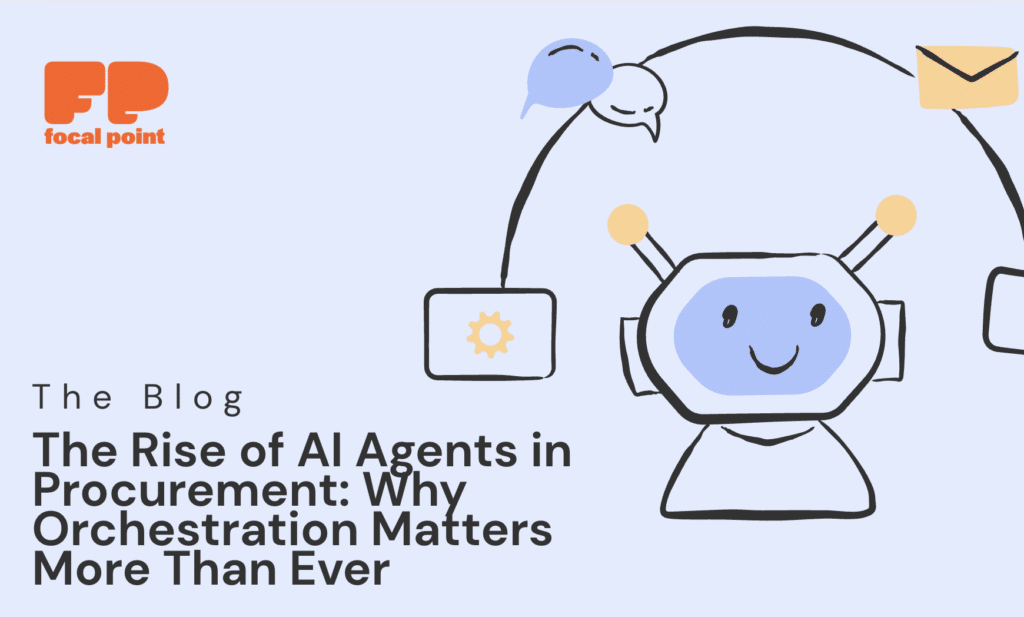
AI agents are not chatbots. They’re not ‘copilots’ either. They’re autonomous digital workers, capable of understanding context, making decisions, and taking real action across your systems. Think of them as micro-specialists: each one designed to do a specific job exceptionally well, without needing a human to push every button.
Here’s what separates them from “chat bots” and other more tactical AI tools:
- They interpret unstructured requests, documents, and emails
- They apply business logic and policies automatically
- They initiate workflows across platforms (from ERPs to Slack)
- They collaborate with other agents and with your team
- And they do it all in the background, in real time
In short, they move work forward instead of just displaying data about it.
Why Procurement Is Uniquely Ready
Procurement sits at the crossroads of complexity. It’s a function built on high-volume, high-variation, high-stakes workflows, exactly the kind of environment where agentic AI thrives.
Teams are dealing with:
- Repetitive, manual intakes processes
- Disconnected tools (CLM, P2P, intake, supplier data, etc.)
- Pressure to hit both financial and non-financial/strategic KPIs
- A growing gap between strategic goals and operational capacity
In this context, AI agents offer a way to scale without simply adding more headcount. They can handle the tactical load, so your people can focus on what matters most; supplier strategy, risk mitigation, internal alignment.

The Orchestration Gap: Why Most AI Initiatives Stall
Here’s the catch: agents don’t work in a vacuum. Most organizations underestimate what’s required to make them succeed.
The biggest blind spots include:
- Fragmented data: making it hard for agents to make reliable decisions
- Lack of orchestration: meaning no clear way to route, prioritize, or coordinate agent actions
- Undefined workflows: agents need structure and policy to operate accurately
- Change management gaps: teams worry about replacement, not augmentation
Without a unified orchestration layer, even the most advanced agents will generate shallow insights or, worse, misfires that erode trust.
A Hybrid Future: Humans + Agents, Aligned
Humans focus on:
- Category strategy
- Complex negotiations
- Supplier relationships
- Business alignment
Agents handle:
- Execution and documentation
- Risk monitoring
- Data gathering and enrichment
- Coordination across systems
This shift allows procurement to evolve from a reactive function into a strategic business center, measured not just by savings, but by visibility, speed, and business impact.

Want the Full Blueprint?
In our full new guide, “AI Agents in Procurement: The Practical Guide to Orchestration Automation & the Future of Digital Procurement” you’ll get:
- A breakdown of the Procurement Agent Stack
- Real-world use cases (intake triage, supplier research, RFP coordination)
- A 3-phase implementation roadmap
- Practical strategies for orchestration, governance, and scale
Download the full eBook to see how leading teams are putting agents to work and how you can too.